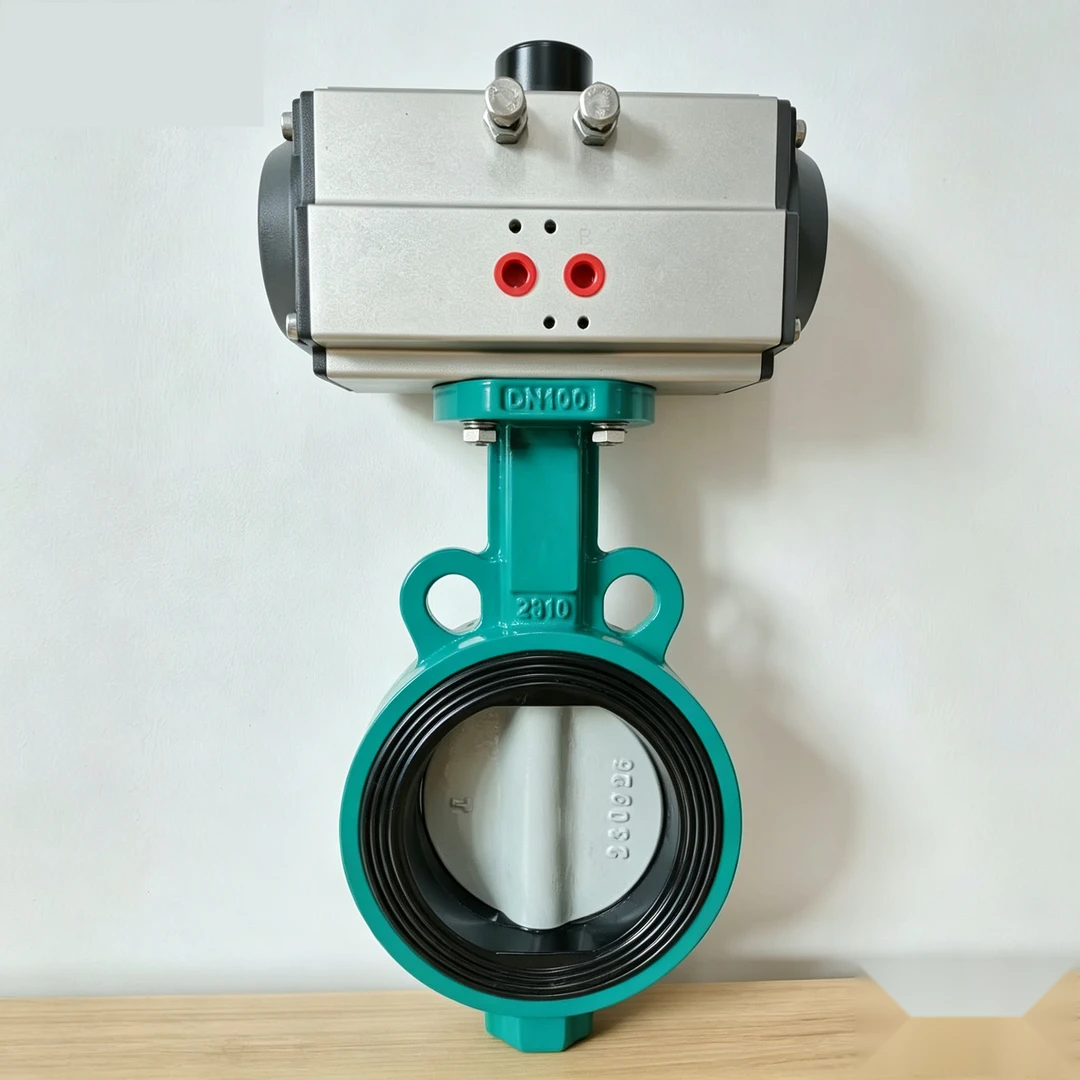
Wafer Type Ball Valve
Wafer Type · DN15–DN200 · PN16/25 · Compact & Light
A wafer ball valve clamps between two flanges with a short, light body — saving weight and cost where space is tight.
Floating ball and PTFE seats give bubble-tight shutoff; available in WCB or SS for PN16/25 duty.
Key Features
Bubble-Tight Shutoff
Soft PTFE seats give zero-leakage shutoff for gas, water and chemical service.
Low Torque
Floating and trunnion designs keep operating torque low for lever or compact actuators.
Anti-Blowout Stem
Stem shoulder and live-loaded packing prevent ejection under line pressure.
Fire-Safe Design
Metal-to-metal backup seat holds line pressure after a fire (design principle; no API 607 certificate held).
Actuator Ready
ISO 5211 flange accepts pneumatic or electric actuators and gearboxes.
Full / Reduced Bore
Full-bore models give unobstructed Cv; reduced-bore saves weight and cost.
Technical Specifications
| Parameter | Specification |
|---|---|
| Body Material | WCB Carbon Steel / SS304 / SS316 / CF8M |
| Ball / Trim | SS304 / SS316 / 17-4PH |
| Seat Material | PTFE / RPTFE / PEEK / Metal |
| Size Range | DN15 – DN600 (1/2" – 24") |
| Pressure Rating | PN16 (ANSI 150 / 300) |
| End Connection | Flanged / Threaded / Welded / Wafer / Tri-clamp |
| Operation | Lever / Gear / Pneumatic / Electric Actuator |
| Bore | Full Bore / Reduced Bore |
| Fire Safe | Fire-safe design with metal backup seat (design principle; no API 607 certificate held) |
| Leakage Class | Bubble-tight, ANSI ISO 5208 Rate A (soft seat) |
| Standards | API 608 / ISO 17292 / GB/T 12237 |
| Certification | ISO 9001:2015, MTC available |
How to Specify a Wafer Type Ball Valve
A wafer (sandwich) ball valve is chosen for the space it saves between flanges. What it gives up is body stiffness, and that decides where it belongs.
Wafer body is a space and cost decision
The valve sits between two flanges with through-bolts, so it is shorter and lighter than a flanged ball valve of the same bore. That is an advantage on skids and manifolds, and a disadvantage where the valve must carry pipe load.
Do not let it carry pipe strain
With no flanged ends of its own, a wafer ball valve depends on the flanges for alignment. Support the pipework either side; do not use the valve as a structural element.
Full bore or reduced bore
Full bore passes a pig and gives negligible pressure drop, but costs more and needs a bigger body. Reduced bore is adequate for most isolation duty and is cheaper at the same line size.
Seat material follows the medium
PTFE and RPTFE cover ordinary liquids and gases; PEEK is for higher temperature; a metal seat is for abrasive or high-temperature service where a soft seat would extrude.
Check the bolt length
A wafer valve needs longer through-bolts than a flanged joint. Confirm the bolt set is included, or plan for it, before installation day.
Installation & Maintenance
Centre the valve before tightening
Tighten the flange bolts evenly in a cross pattern with the valve supported centrally. Off-centre tightening distorts the body and loads the seat.
Leave room for the lever or actuator
The handle swings through 90 degrees and needs clearance. On a dense manifold this is discovered too late.
Do not use it as a blind
A wafer ball valve between two flanges is not a spectacle blind. Where positive isolation is required, specify a proper blind arrangement.
Exercise it periodically
Ball valves that sit in one position for years take a set in the seat. A quarter-turn every few months keeps it operable.
Common Specification Mistakes
Using it to pull misaligned flanges together
A wafer body has less stiffness than a flanged one and will distort.
Forgetting the longer through-bolts
The valve arrives and there is nothing to bolt it up with.
Assuming wafer always means cheaper overall
Once you add bolts, gaskets and supports the saving can disappear.
Frequently Asked Questions
What is the difference between floating and trunnion ball valves?
Floating ball valves seat the ball against the downstream seat by line pressure (DN15–DN150). Trunnion-mounted balls are held by top and bottom shafts for larger sizes (DN200+) and higher pressures.
Which seat material should I choose?
PTFE / RPTFE for most chemicals and clean fluids up to +200°C. PEEK for higher temperature. Metal seat for slurry, abrasive or high-temperature service.
Can ball valves be used for throttling?
Ball valves are best for on/off. For modulating duty use our V-port control ball valves or control valves, which keep a stable characteristic curve.
Applications & Use Cases
Oil & Gas
Pipeline isolation, tank farm and loading arms with fire-safe soft seats.
Water & Utilities
Municipal water, HVAC and irrigation with flanged or wafer ends.
Chemical
Corrosive media handled in SS316 or PTFE-seated bodies.
Food & Pharma
Tri-clamp and polished SS316 ball valves for hygienic lines.